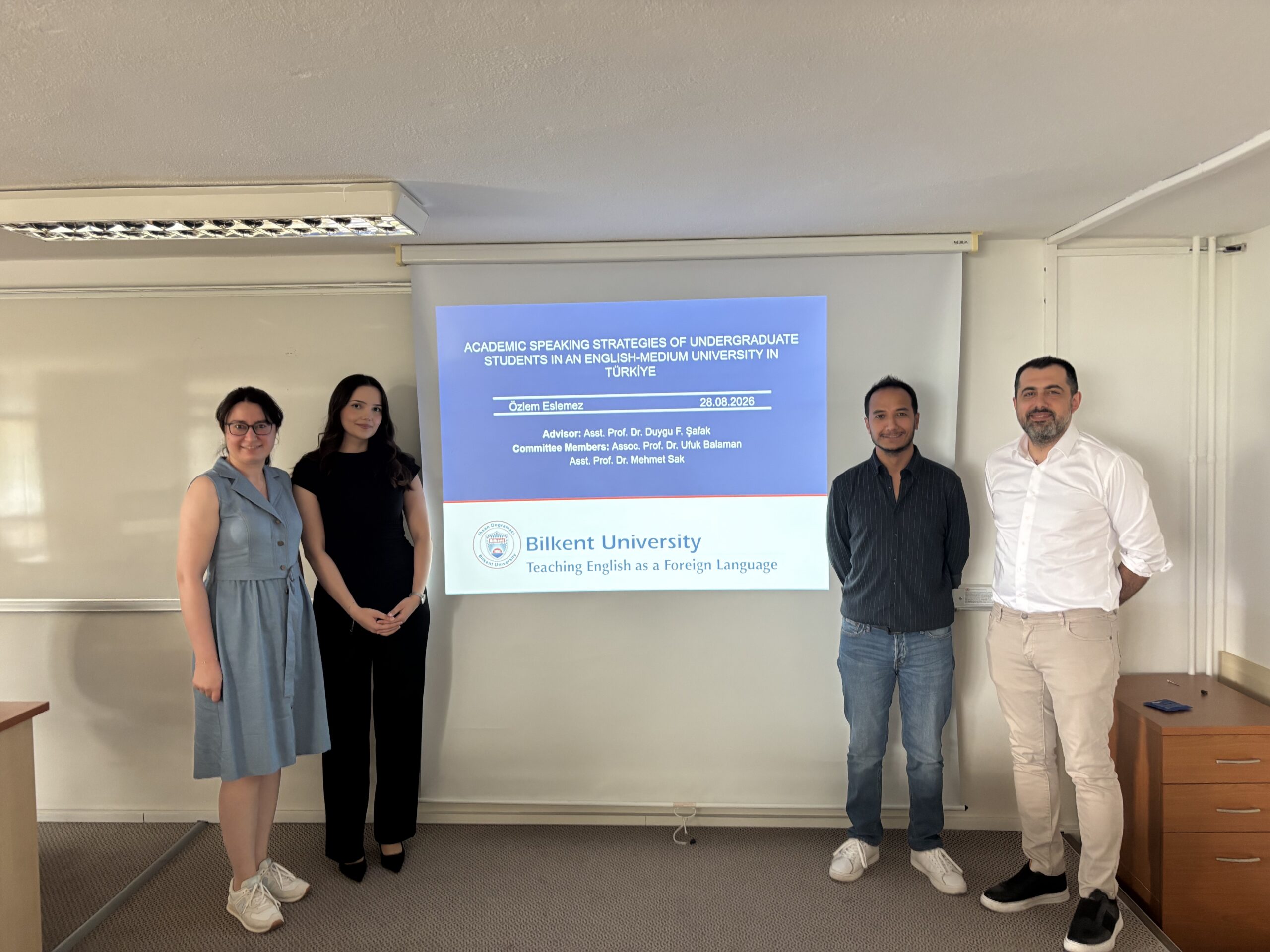
Eslemez’s thesis investigates undergraduate students’ self-reported academic speaking strategies in an English-medium university in Türkiye. Using a mixed-methods design, she examined strategy use through questionnaire data and interviews. The main findings indicate that students’ speaking strategies were flexible and context-dependent, with variations across particular participant characteristics and academic contexts.
Title of Thesis: Undergraduate Students’ Self-Reported Academic Speaking Strategies in an English-Medium University in Türkiye
Supervisor: Asst. Prof. Dr. Duygu Fatma Şafak
Jury Members: Asst. Prof. Dr. Duygu Fatma Şafak, Assoc. Prof. Dr. Ufuk Balaman (external), Asst. Prof. Dr. Mehmet Sak (external)
Defence Date: 28.08.2026
The abstract of the thesis is as follows:
Using a mixed-methods design, this study investigated the self-reported speaking strategies used by undergraduate students at a public English-medium university in Türkiye during speaking-focused academic encounters. It also examined whether these strategies differed according to participant characteristics and explored how they described the purposes and contexts of their strategy use. Quantitative data were collected from 198 undergraduate students based on the 25 speaking items from Wright et al.’s (2022) EAP-Adapted version of Nakatani’s (2006) Oral Communication Strategy Inventory (OCSI). Descriptive statistics and nonparametric tests were used to analyze the data at the item level, as the psychometric findings did not support composite scores. Qualitative data were collected through semistructured interviews with eight participants and analyzed through within-case and cross-case pattern analysis. The findings showed that participants generally reported maintaining communication, adjusting their messages, monitoring the listener’s comprehension, and continuing to speak despite potential mistakes. Group-based differences by gender, department group, year of study, English preparatory school attendance and length, and foreign language education status were limited to particular items and generally had small effect sizes. The interview findings showed that participants often prioritized meaning in many interactions, accuracy, particularly during formal tasks, reformulated and simplified their messages, used first language (i.e., L1) to formulate or repair their messages, and drew on translation, visual resources, and contextual knowledge. Taken together, these findings suggest that reported academic speaking strategies were flexible and context-dependent.
Keywords: academic speaking, oral communication strategies, English-medium instruction, English for academic purposes, undergraduate students, mixed methods